LiteLLM Enterprise is an option for companies standardizing how their teams and applications access generative AI.
It provides enterprise identity and access controls, key management, budgets and rate limits, spend tracking, guardrails, logging, multi-region deployment, MCP and agent controls, and enterprise support. But a production decision rarely comes down to a feature list alone.
The harder questions start after the shortlist:
- How much of our AI operating model does LiteLLM Enterprise cover out of the box?
- What will we need to configure or integrate?
- What will we have to build ourselves?
- How does it perform under our workload?
- What does support actually cover?
- What does deployment cost once you include infrastructure and engineering?
This guide takes a technical look at LiteLLM Enterprise as a production platform—its capabilities, architecture, extensibility, performance, support model, pricing, and total cost of ownership.
1. What Does LiteLLM Enterprise Give You?
Before evaluating the trade-offs, it helps to establish what LiteLLM Enterprise actually provides. LiteLLM Enterprise adds enterprise identity, security, governance, deployment, and support capabilities around the core gateway.
LiteLLM Enterprise capabilities
| Area | What Enterprise provides |
|---|---|
| Access & identity | SSO, SCIM, OIDC/JWT, organizations, teams, delegated administration |
| Credential & security | Virtual-key rotation, secret-manager integrations, IP allowlists, public/private routes |
| AI governance | Budgets, rate limits, guardrails, spend tracking, audit/management logs |
| Observability | Request/response logging and routing to external platforms such as Langfuse, LangSmith, and Arize |
| AI infrastructure | Multi-provider access, routing, load balancing, fallbacks, multi-region deployment |
| Agents & tools | MCP Gateway, key/team/org permissions, agent budgets and session controls |
| Deployment | Self-hosted, air-gapped deployment, one or multiple logical production deployments depending on plan |
| Support | Enterprise support and custom SLA options |
Not every capability listed here is Enterprise-exclusive. LiteLLM Enterprise adds enterprise identity, security, administration, deployment, and support capabilities around the core gateway.
What does LiteLLM Enterprise cost?
LiteLLM Enterprise Standard starts at $30,000 per year, billed annually. Scale is custom-priced. The final price depends on factors including gateway request capacity, deployment architecture, and support requirements.
| Features | Standard | Scale |
|---|---|---|
| Starting price | $30,000/year | Custom |
| Production deployment | 1 logical production deployment | Multiple logical production deployments |
| Request capacity | Annual capacity included | Sized to expected traffic |
| Deployment | Self-hosted; air-gapped available | Self-hosted; air-gapped available |
| Support | Standard support | Enterprise support; 24/7 SLA options |
| Best suited for | Initial production and controlled enterprise rollouts | Enterprise-wide, high-volume, customer-facing, or regulated deployments |
Where implementation gets interesting
The feature list only tells part of the story.
Take budgets, for example. LiteLLM supports budgets across different entities, including users, teams, keys, models, and agents. But those controls depend on the underlying deployment: LiteLLM's documentation notes that budget enforcement requires a database.
The same applies to MCP and agent workloads. LiteLLM's MCP Gateway provides a centralized endpoint and permissions based on keys, teams, and organizations, while its agent controls include limits such as session iterations and dollar budgets.
These implementation details matter because having a feature available isn't the same as understanding what it takes to run it in production.
And that's where we'll go next.
2. How Far Can You Extend LiteLLM Enterprise?
LiteLLM Enterprise provides several ways to adapt the gateway to a specific environment, including configuration, integrations, hooks, callbacks, plugins, and custom routing strategies.
But extensibility is not the same as configurability.
Configuration may require little engineering. Integrations, custom routing, and callbacks can introduce code that your team must maintain.
| Requirement | LiteLLM's documented approach |
|---|---|
| Configure model routing | Routing configuration |
| Configure key/team-specific routing | Key/team router settings |
| Add custom routing logic | Custom routing strategies |
| Send events to an external system | Callbacks |
| Inspect or modify requests | Pre-call hooks |
| Inspect or modify responses | Post-call hooks |
| Reject requests based on custom logic | Request hooks |
| Connect external observability | Built-in integrations/callbacks |
| Proxy APIs that aren't natively supported | Pass-through endpoints |
| Add custom gateway behavior | Plugins/extensions |
LiteLLM Enterprise can be extended. The more important question is what kind of extension your requirement calls for—and what your team will build and maintain.
Configuration vs. code
Consider custom request handling. If the requirement fits LiteLLM's existing configuration or guardrail framework, you may need little additional code. If it requires custom logic before or after a model call, hooks and callbacks provide an extension path. Requirements outside those mechanisms may require custom code or another service.
The same applies to routing: LiteLLM provides built-in strategies and a framework for custom routing.
This creates four levels of implementation:
| Level | What it means | Ownership |
|---|---|---|
| Configuration | Use an existing LiteLLM capability | Platform team operates configuration |
| Integration | Connect LiteLLM to an existing system | Team owns integration and configuration |
| Extension | Use hooks, callbacks, plugins, or custom routing | Team owns the extension |
| Custom system | Build functionality outside the gateway | Team owns another production component |
Once you understand what you can configure, integrate, or extend, the next question is what Enterprise support covers when those capabilities become part of production infrastructure.
3. What Does LiteLLM Enterprise Support Look Like?
If an AI gateway becomes critical production infrastructure, what support and SLA are you actually buying?
LiteLLM Enterprise includes a dedicated support channel and support for LLM/provider integrations, deployment, upgrade management, and provider troubleshooting. Infrastructure-specific issues remain the customer's responsibility, although LiteLLM provides guidance.
| Support area | LiteLLM Enterprise |
|---|---|
| Support channel | Dedicated |
| LLM/provider integrations | Included |
| Deployment assistance | Included |
| Upgrade management | Included |
| Provider troubleshooting | Included |
| 24×7 support | Available on Scale |
| Custom SLAs | Available |
The Enterprise pricing material specifies a 1-hour response for Sev0, 6 hours for Sev1, and 24 hours for Sev2–Sev3, with a 72-hour SLA for vulnerability patches. Custom SLAs are also available.
| Support area | Forgebench |
|---|---|
| Support channel | Dedicated |
| Deployment assistance | Included |
| Product issues | Included |
| Infrastructure issues | Included (if not Self-hosted) |
| Self-hosted / BYOC support | Included |
| SLA options | Included |
| 24×7 support | Included |
4. What Does LiteLLM Enterprise Actually Cost?
LiteLLM Enterprise Standard starts at $30,000 per year, billed annually. Scale is custom-priced, with the final cost depending on factors including gateway request volume, deployment architecture, and support requirements.
Enterprise license
| Plan | Starting price | Intended for | Deployment |
|---|---|---|---|
| Standard | $30,000/year | Initial production deployments and controlled enterprise rollouts | One logical production deployment |
| Scale | Custom | Enterprise-wide rollouts, high-volume traffic, customer-facing or regulated deployments | Multiple logical production deployments |
What influences the Enterprise quote?
| Pricing input | Why it matters |
|---|---|
| Deployment scope | Whether LiteLLM serves one business unit or the broader enterprise |
| Production applications | Number of applications expected to route through the gateway |
| Gateway request volume | Expected monthly or annual request volume |
| Deployment architecture | One deployment versus multiple isolated deployments across regions, databases, or control planes |
| Developers governed | Number of developers receiving governed AI access |
The $30,000 starting price is a license baseline. Actual cost depends on the deployment's scale and architecture.
What does it cost to operate?
The license is only one component of total cost of ownership (TCO). A production deployment may also require:
- Infrastructure — compute, database, networking, storage, and observability.
- Engineering and operations — deployment, upgrades, security, reliability, monitoring, and incident response.
- Custom integrations — identity, observability, internal tooling, and workflow integrations.
- Additional governance — controls that sit outside the gateway.
The more useful question is not simply “What is the LiteLLM Enterprise license?” but “What will LiteLLM Enterprise cost us to run as part of our AI platform?” The calculator below helps estimate that broader TCO.
5. Interactive Calculator: What Is Your LiteLLM Enterprise TCO?
Estimate your annual LiteLLM Enterprise TCO(Total Cost of Commercial) by combining the license with infrastructure, engineering, operations, and additional governance costs.
This is a planning estimate, not a LiteLLM commercial quote.
LiteLLM Enterprise TCO Calculator
Note: This calculator provides an estimate based on the inputs provided. It is not a LiteLLM quote. Actual LiteLLM Enterprise pricing depends on factors including request volume, deployment architecture, and support requirements.
Could you reduce the engineering and governance layer around your gateway?
See how Forgebench works with LiteLLM to govern identity, budgets, credentials, agents, tools, attribution, and audit.
[See How Forgebench Fits Your Architecture →]
6. When LiteLLM Enterprise Isn't the Whole AI Operating Layer
LiteLLM Enterprise covers the gateway, identity, access controls, budgets, observability, MCP, agents, and a range of governance functions. The question is what happens when governance needs to extend across the systems surrounding the gateway.
| Requirement | LiteLLM Enterprise | What may still require another layer | Forgebench |
|---|---|---|---|
| Identity & tenant isolation | SSO, SCIM, organizations, teams, projects, and keys | Stronger isolation or a separate trust boundary | Database-enforced, fail-closed tenant isolation |
| Pre-execution authorization | Budgets, rate limits, guardrails, key/team permissions, MCP controls | Authorization spanning identity, budget, credentials, and tools | Governed checks before the request reaches LiteLLM |
| Credential ownership | Provider credentials and secret-manager integrations | Centralized ownership and lifecycle across tenants, developers, and agents | Per-tenant encrypted credential vault |
| Agent & tool governance | Agent access, budgets, session controls, and MCP permissions | Broader lifecycle, versioning, tool policy, and approval workflows | Agent registration, lifecycle controls, and tool bindings |
| Developer AI governance | Coding-agent routing and usage attribution | Developer-level policy, ceilings, and workflow governance | Developer-level governance and usage ceilings |
| Attribution & audit | Spend tracking, management logs, and request/activity logging | Evidence and attribution spanning workflows, credentials, policies, and business systems | Workflow-level attribution and hash-linked audit record |
The distinction is not whether LiteLLM Enterprise has governance capabilities; it does. The distinction is how far those controls extend beyond the gateway and how much additional architecture is required to connect them.
7. Forgebench + LiteLLM: What the Combined Architecture Looks Like
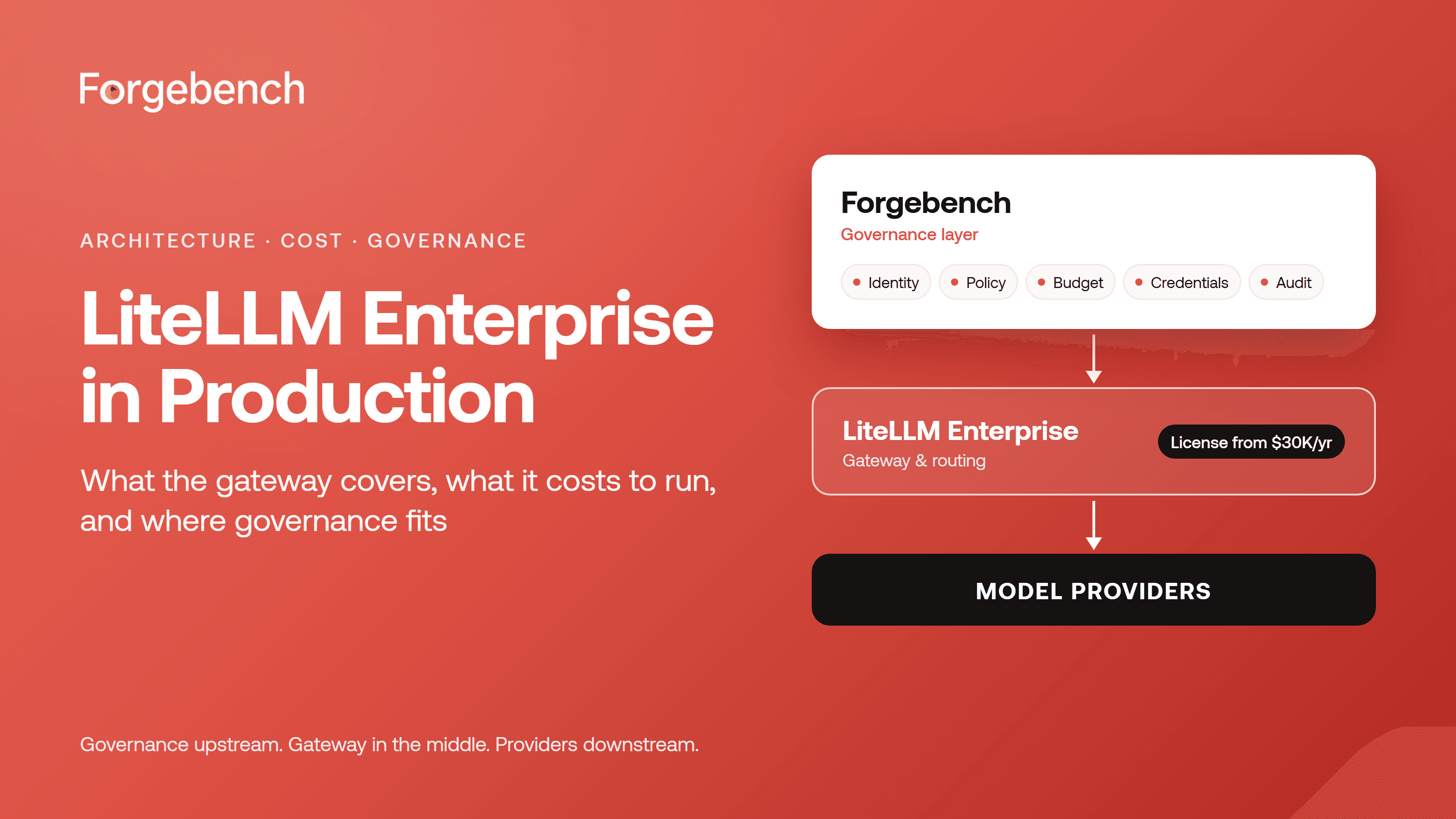
If LiteLLM remains the gateway, Forgebench can sit upstream as the governance layer:
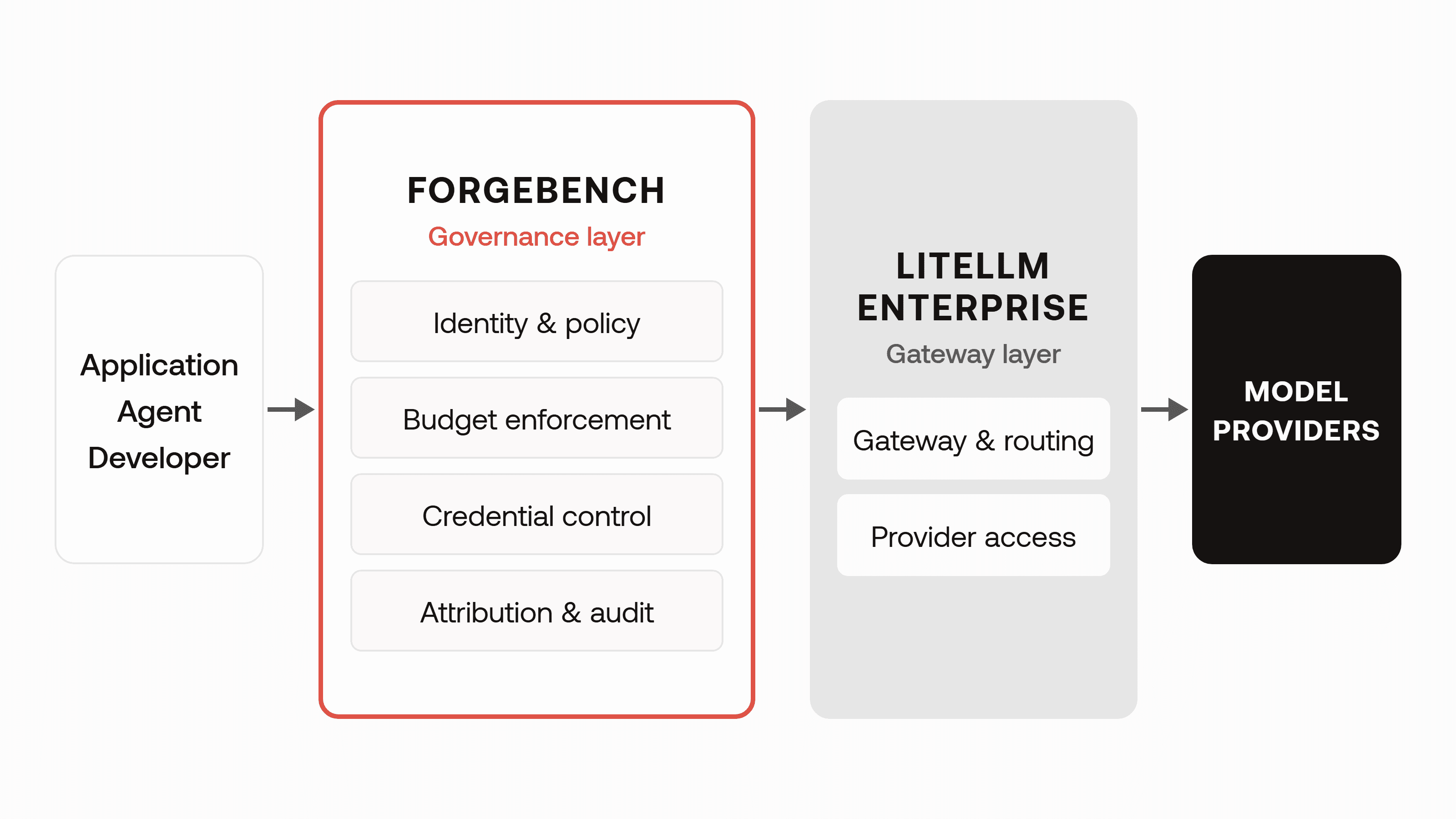
Request path:Identity → policy → budget → credential → LiteLLM → provider → attribution → audit
| Layer | Primary responsibility |
|---|---|
| Forgebench | Controls who or what can make the request, under which policy and budget, with which credentials, and how the activity is attributed and recorded |
| LiteLLM Enterprise | Provides the gateway layer for provider access and routing |
| Model provider | Executes the model request |
8. Build Around LiteLLM Enterprise or Buy the Additional Layer?
The decision generally comes down to three paths:
Stay with LiteLLM Enterprise
Use LiteLLM Enterprise as-is when it covers your gateway and governance requirements and fits your existing platform architecture.
Extend LiteLLM Enterprise
Extend it when the gaps are specific, and your engineering team wants to own the implementation. LiteLLM provides hooks, callbacks, plugins, integrations, and custom routing for this purpose.
The real cost is not just development. Custom functionality becomes part of your team's testing, security, upgrade, and maintenance burden.
Add a governance layer
Consider an additional layer when governance needs to span agents, tools, developers, applications, credentials, budgets, attribution, and audit beyond the gateway itself.
Forgebench takes this approach by using LiteLLM as the gateway while providing the surrounding governance layer.
The economic decision
The relevant comparison is not LiteLLM Enterprise vs. Forgebench pricing. It is:
LiteLLM Enterprise + infrastructure + engineering + custom governance
versus
LiteLLM Enterprise + governance platform
The question is whether building and operating the additional control layer is justified—or whether adopting one makes more sense.
9. The CTO's LiteLLM Enterprise Decision Checklist
Before choosing how to deploy or extend LiteLLM Enterprise, ask:
Product fit
- Does LiteLLM Enterprise cover our current gateway and governance requirements?
- Which requirements need additional components?
Extensibility
- Which gaps can be configured?
- Which require custom engineering?
- Who owns and maintains those customizations?
Production
- What latency, throughput, infrastructure, deployment model, and SLA do we need?
Economics
- What will be the license, infrastructure, engineering, operations, and additional governance cost?
Architecture
- What should LiteLLM own?
- Where should identity, credentials, policy, attribution, and audit live?
- Do we need an additional control layer?
If LiteLLM Enterprise covers the requirements and fits your existing platform, use it.
If the gaps are specific and your engineering team can reasonably own them, extend it.
If governance needs to span the gateway and the workloads around it, evaluate whether building that additional layer is justified or whether adopting one makes more sense.