

Gateway
The model-agnostic chokepoint: the model catalog, reliability routing, fallbacks and response caching, on one page. No client reaches a provider directly — every call is routed, cached, budget-gated, metered and audited here.
This page is read-only visibility into a policy your platform administrator manages — there is no edit control here.
Call the gateway
The gateway exposes an OpenAI-compatible endpoint. Point any OpenAI client at
it and pass an sk_... key — no provider credential ever leaves your code.
curl -X POST https://api.forgebench.ai/v1/chat/completions \
-H "Authorization: Bearer sk_..." \
-H "Content-Type: application/json" \
-d '{
  "model": "mock-gpt",
  "messages": [{"role": "user", "content": "hello"}]
}'
from forgebench import Forgebench
client = Forgebench(api_key="sk_...", base_url="https://api.forgebench.ai")
resp = client.chat.completions.create(
model="mock-gpt",
messages=[{"role": "user", "content": "hello"}],
)import { Forgebench } from "@seedlinglabs/forgebench-sdk";
const forgebench = new Forgebench({ baseUrl: "https://api.forgebench.ai", apiKey: "sk_..." });
const res = await forgebench.chat.create({
model: "mock-gpt",
messages: [{ role: "user", content: "hello" }],
});Response is OpenAI-shaped plus one addition — trace_id — see
Quickstart for the full body.
The model catalog
A flat, searchable list of everything a call can use: label, provider, whether it has a fallback chain, availability, and price per 1K tokens (or per image, for image models). Local and unpriced models read "free"; a model needing a key you haven't configured shows as unavailable, with a link to add one.
Two summary figures sit above the list: the total model count, and how many of them have a fallback chain configured — a quick answer to "how protected is this deployment" without reading every row.
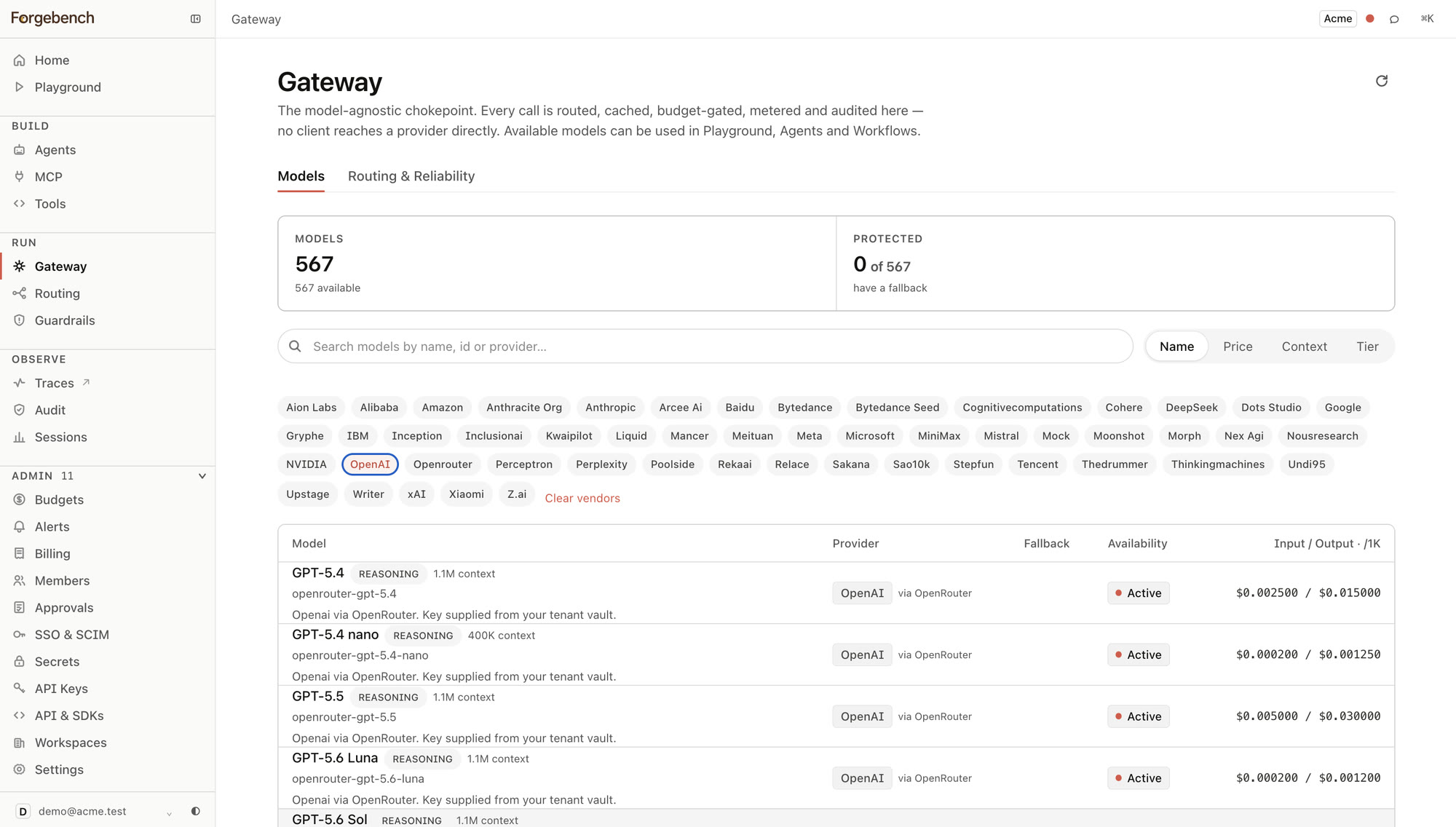
Sort by name, price, context window or tier. Filter by vendor as the catalog grows — the chips are generated from whatever the deployment actually serves, not a fixed list.
Available models are usable in Playground and in an agent's own model choice, within whatever the calling key's allowlist permits.
Reliability routing and fallbacks
Every call is load-balanced across providers, retried on failure, and escalated through a fallback chain automatically — none of it is client-side retry logic you have to write.
| Setting | What it controls |
|---|---|
| Load balancing | How traffic is spread across providers serving the same model. |
| Retries | Attempts per call before failing over to a fallback. |
| Timeout | How long a single attempt is given before it's treated as failed. |
| Circuit breaker | Failures before a provider is temporarily taken out of rotation, and how long it stays out. |
A model marked protected in the catalog has a configured fallback chain. There are two distinct triggers a chain can fire on — worth knowing apart, since they mean different things went wrong:
- On failure — the primary model errored or is unavailable.
- Over context limit — the request is too large for the primary model's context window.
Either way, the call escalates to the next model in the chain automatically.
Response cache
A cache hit skips the provider call entirely — but the request is still budgeted, metered and audited exactly as if it had gone through. Caching never becomes a hole in the record.
Isolation is per tenant, always — a cache entry is never shared across tenants. Retention is a fixed TTL set centrally.
Gateway vs Routing
Both pages sit at the same chokepoint and split one job in half. Gateway owns reliability routing — which provider instance serves a model, retried and failed-over automatically, invisible to the caller. Routing owns capability routing — which model a request should use in the first place, based on what the request needs. Configure a model's fallback chain here; configure which requests reach which model in Routing.